Knock And The Door Shall Be Opened (Luke 11)
Luke 11
This is a recap of our Bible Caller Club meeting on July 17th, 2026 over this passage. If you want to join the club and attend future meetings and study with us via phone, click here.
Context:
In our Bible study on the evening of July 17, 2026, we continued our journey through the Gospel of Luke. Coming out of chapter 10, which focused on receiving God's kingdom, this week we saw how chapter 11 shifts the theme to asking for God's kingdom, a concept that appeared repeatedly throughout our reading and discussion.
What is happening in this passage?
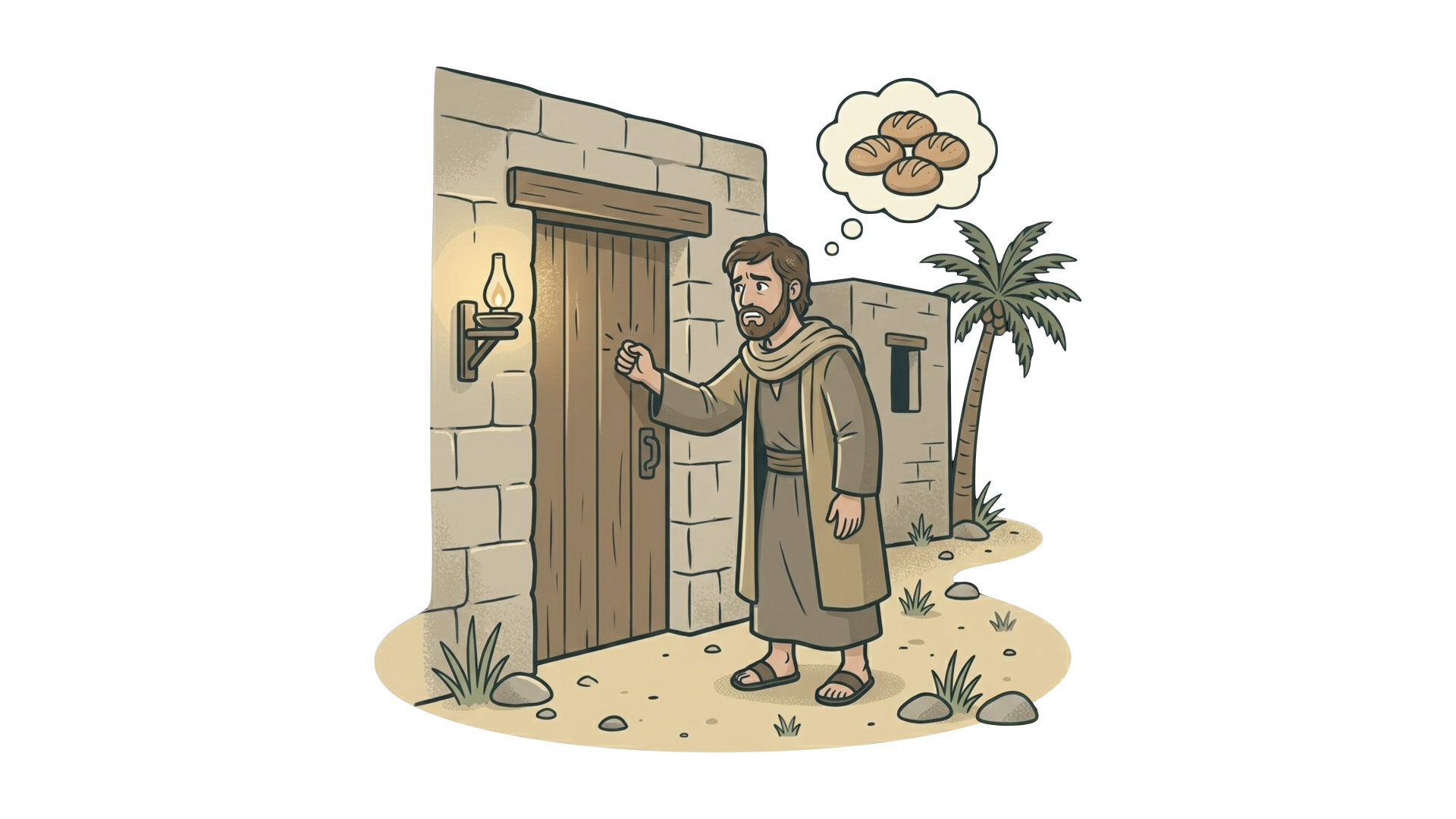
Our group read through the entirety of Luke chapter 11, which covers a wide range of Jesus's teachings and interactions. The chapter opens with the disciples asking Jesus to teach them how to pray, which leads to the Lord's Prayer (v. 1-4). Following this, Jesus tells a parable about a persistent friend asking for bread at midnight, using it to teach the importance of persistently asking, seeking, and knocking (v. 5-13). As one club member pointed out during our study, this section emphasizes that our Heavenly Father, being a perfect father, desires to give good gifts—specifically the Holy Spirit—to those who ask Him. The scene then shifts to Jesus casting out a demon, which prompts a division among the crowd. Some accuse him of using the power of Beelzebul, the ruler of demons (v. 14-16). Jesus refutes this, explaining that a kingdom divided against itself cannot stand and that He casts out demons by the "finger of God," signifying the arrival of God's kingdom (v. 17-23). The passage continues with warnings about an evil spirit returning to a "swept clean" but empty house, a woman blessing Jesus's mother, and Jesus's own declaration that those who hear God's word and keep it are the ones who are truly blessed (v. 24-28). The latter half of the chapter involves Jesus rebuking the generation for seeking a sign, condemning the Pharisees for their hypocrisy and focus on outward cleanliness over inward justice and love (v. 37-44), and warning the scholars of the law for creating burdens and holding "the key of knowledge" without entering or letting others enter (v. 45-54).
What is God revealing about humanity in this passage?
In our study tonight, we noted that this chapter reveals a deep divide within human nature. We saw that humanity is prone to being judgmental and hypocritical. As one person shared, we often worry more about how we appear to others while "missing the whole point, which is cleaning the inside" (v. 39-41). The Pharisees served as a prime example of this; they invited Jesus into their home but immediately judged him for not following their external traditions. This led to a great insight from one of our youngest members: "Humanity's just like a worm, and God's like an apple. Humanity will try to bite through the apple. Then the birds will come and take that worm away." This illustrates how people, like the Pharisees, try to take advantage of God or test Him for their own selfish reasons. When confronted with their sin, their pride leads them to reject God's kingdom rather than repent. Another member pointed out that people have a hard time "emptying out" and letting go of the past, clinging to old ways instead of wholeheartedly embracing the new life God offers.
What is God revealing about himself in this passage?
The most powerful revelation about God in this chapter, as our group discussed, is His nature as a good and patient Father. He presents Himself as One who desperately desires to give His kingdom and the Holy Spirit to those who persistently ask in faith (v. 9-13). As someone mentioned, "He's waiting for us to ask Him." He is not a reluctant giver but a loving Father who gives better gifts than any earthly father ever could. Furthermore, God reveals Himself as the "stronger one" who has come to defeat evil and establish His kingdom (v. 22). He is not divided against Himself; His power is singular and absolute. He is the one we must listen to because, as a club member noted, "His ways are higher than our ways," and He alone can show us the true path of His kingdom. He is the source of knowledge and wisdom, and He freely gives it to those who come to Him with a pure heart.
How should our lives change having studied this passage?
After studying this passage, our group concluded that we must actively work on our priorities. As one person pointed out, so many of the negative examples in the chapter—from the Pharisees to those accusing Jesus—stemmed from having the wrong priorities, like image and pride. We should strive to be like the Queen of the South, who prioritized seeking wisdom, and the people of Nineveh, who prioritized repentance (v. 31-32). Secondly, we cannot just be hearers of the word; we must also be doers. Jesus makes it clear that being blessed comes from hearing the word of God and keeping it(v. 28). This means we are called to do something with the knowledge of the kingdom we receive. We can't just clean out the sin in our lives; we must actively fill that space with God's kingdom. Finally, we must choose to gather with Jesus instead of scattering against Him (v. 23). This requires us to stop being self-righteous and to start actively and persistently asking for God's kingdom to transform us from the inside out, so we can be a light on a lampstand for all to see.