Let Us Go and See This Thing That Has Happened (Luke 2:1-20)
Luke 2:1-20
This is a recap of our Bible Caller Club meeting on July 3rd, 2026 over this passage. If you want to join the club and attend future meetings and study with us via phone, click here.
Context:
In our study on Friday, July 3rd, 2026, we continued our journey through the Gospel of Luke. Luke is writing an orderly, historical account so that his readers can "know with certainty about the things you have been taught" (Luke 1:4), and this passage, the famous Christmas story, flows directly from the angelic announcements in chapter one, showing how God's plan was set in motion.
1. What’s happening in this passage?
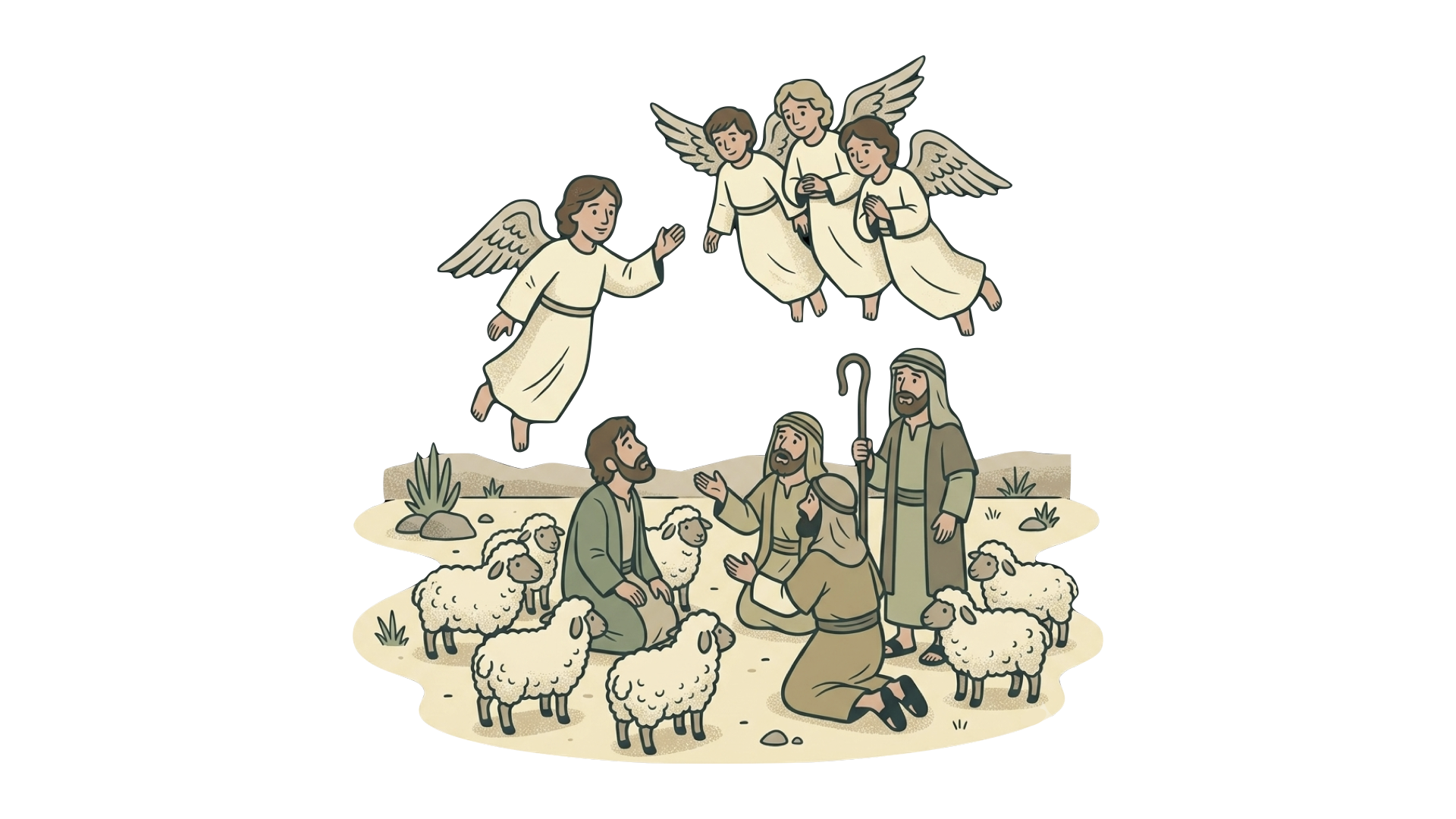
In our study tonight, we read through the account of Jesus’ birth (Luke 2:1-20). The passage begins by grounding the story in specific history, with a decree from Caesar Augustus for a census while Quirinius was governor of Syria (vv. 1-2). This required Joseph and a very pregnant Mary to travel from Nazareth to Bethlehem (vv. 3-5). While there, Mary gave birth to Jesus, her firstborn son. As one club member pointed out, there was no room for them in the guest room, so the Son of God was born in a humble stable and laid in a manger (vv. 6-7). This humble beginning fulfills the theme of Mary’s own prayer in chapter one, where she praised God for exalting the humble. Nearby, an angel of the Lord appeared to shepherds, calming their fear and announcing the "good news of great joy," the birth of the Savior, Christ the Lord (vv. 8-12). A multitude of the heavenly host then appeared, praising God. After the angels left, the shepherds decided to go to Bethlehem to "see this thing that has happened" (v. 15). They found Mary, Joseph, and the baby just as the angel had described. They then began telling everyone what they had seen and heard, amazing all who listened (vv. 15-18). The passage concludes with Mary treasuring these events in her heart and the shepherds returning to their fields, "glorifying and praising God for all they had heard and seen" because everything had happened "just as it was told to them" (vv. 19-20).
2. What is God revealing about humanity?
During our discussion, several points were raised about what this passage shows us about humanity. One member noted how the historical details—names, places, and events like the census—are included to prove that Jesus was a real person, highlighting a very human need for evidence and certainty, which Luke is directly addressing. The shepherds' first reaction to the angel was fear (v. 9), which a member noted is often our own reaction when God’s plan enters our lives unexpectedly. We are often afraid of stepping out of our comfort zones. However, the study also highlighted a more positive human response in the shepherds' decision to "go to Bethlehem then and see this thing" (v. 15), which shows our capacity to respond to God's call. Another person brought up how the shepherds didn't ask for a sign, but God offered one anyway: "you will find a baby wrapped in cloths and lying in a manger" (v. 12). This was compared to Zechariah asking for a sign in chapter one, showing that God understands our human tendency to want proof. Furthermore, the passage emphasizes Jesus’ complete humanity. As a participant shared, it’s important to understand that Jesus was a real baby who needed his diaper changed and had to learn to talk, just like any other person. He was fully human.
3. What is God revealing about Himself?
Our group found that this passage reveals God's meticulous sovereignty and his divine nature. It was pointed out that the repetition of words like "it happened" emphasizes that everything was unfolding precisely according to God’s plan. As one member powerfully stated, God can use anyone and any circumstance to bring about his purpose, even using the decree of a pagan Roman emperor to move Mary and Joseph to the exact city where prophecy said the Messiah would be born. We learned that God's plan brings "good news of great joy which will be for all people" (v. 10). He is a God who has a mighty plan and puts it into action. One member beautifully connected chapter one to chapter two by observing that while Mary was introduced to the Messiah through a supernatural angelic announcement, God now used angels to bring this same divine message to humble shepherds. This shows the dual nature of the event: Jesus was 100% human, born in a manger, but his arrival was also 100% divine, announced by heavenly hosts. Another member mentioned how God is giving us insight into the spiritual world, pulling back the curtain to show us a reality beyond our own, if we are willing to look. He is a God who can use flawed and ordinary people to weave a magnificent story of redemption.
4. How should our lives change?
As we concluded our study, the biggest application we took away was the need to check our attitude in all of life's situations. Are we praising God in the highs and the lows? One person mentioned how Mary, faced with giving birth in a barn, "took it with absolute stride," praising God instead of complaining. This is a profound lesson for us: to trust God and find reasons to praise Him even in stressful or less-than-ideal situations, choosing to treasure up these events and ponder them in our hearts (v. 19). Another key takeaway is the importance of witnessing. As one member explained, Luke deliberately included witnesses like the shepherds to provide testimony. Once the shepherds saw Jesus for themselves, they couldn't help but go and tell others. Similarly, one member felt moved to be more bold in sharing the gospel. The angels' message was "Do not be afraid" (v. 10), and that message is for us as well. We need to "keep watch" (v. 8), looking for the ways God can use our own humble circumstances for His good. Finally, we must act quickly when God gives us an opportunity. The shepherds hurried to see Jesus, and because they did, they received a testimony to share. We too must be ready to respond quickly to God's invitations, to go and see, so that we can then go and tell.