Test Yourselves to See if You Are in the Faith (2 Corinthians 13)
2 Corinthians 13
This is a recap of our Bible Caller Club meeting on May 31st, 2026 over this passage. If you want to join the club and attend future meetings and study with us via phone, click here.
Context:
In our Bible study on the night of May 31, 2026, we concluded our journey through the book of 2 Corinthians. As was pointed out, the apostle Paul has spent the entire book defending his authority and apostleship against the Corinthian church's doubts, all leading up to this final, passionate plea for them to repent before his third visit.
1. What’s happening in this passage?
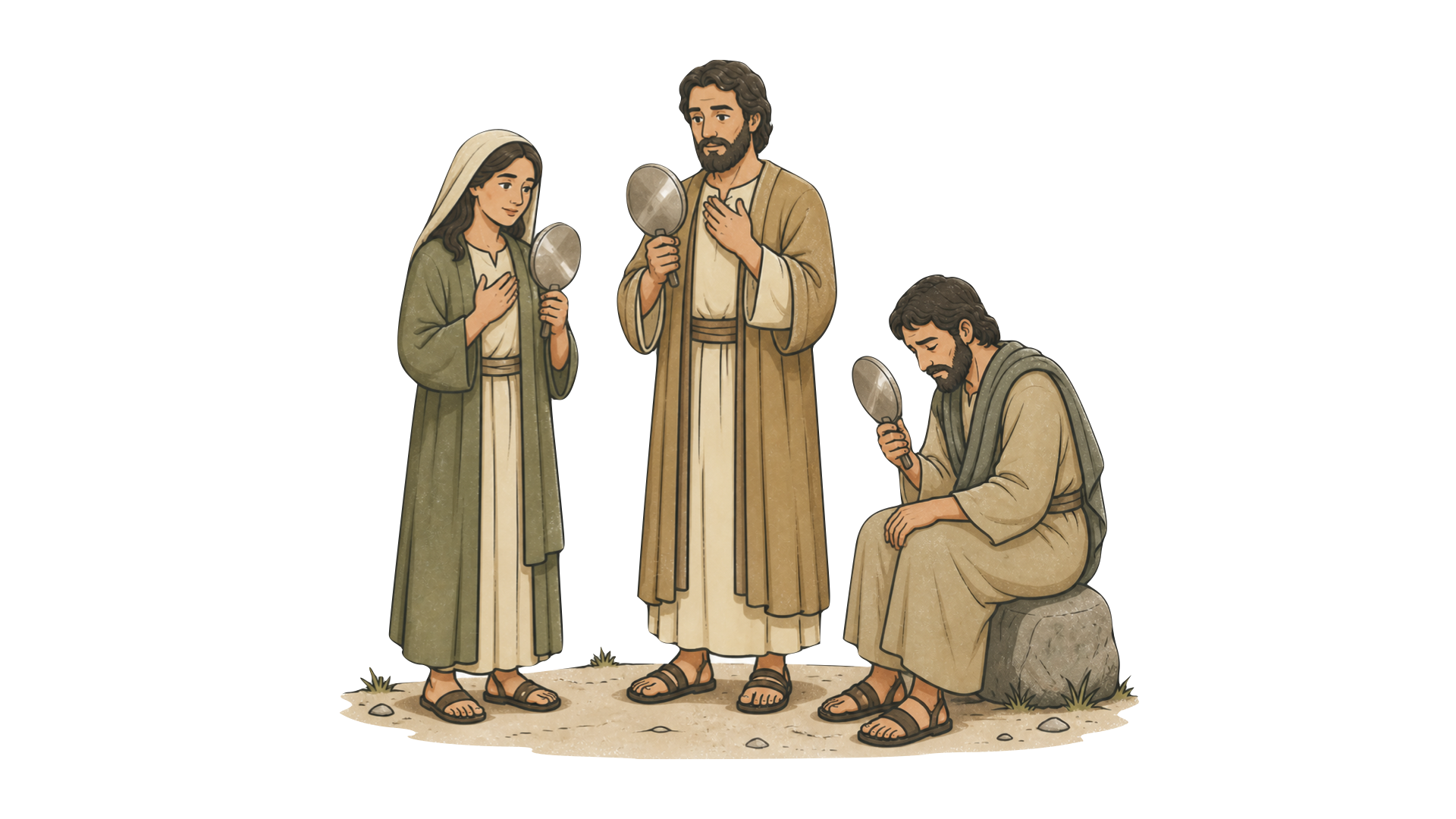
In our study tonight, we explored the final chapter of 2 Corinthians, which opens with Paul announcing his impending third visit to the Corinthian church (13:1). As we discussed, this visit serves as a final warning. Paul quotes the Old Testament law that "every matter shall be confirmed by the mouth of two or three witnesses," and it was pointed out that Paul seems to be treating his three separate visits as these very witnesses against their unrepentant sin. He states plainly that if he comes again and finds them still in sin, he "will not spare anyone" (13:2). The Corinthians had been seeking proof that Christ was speaking through Paul, and he turns this back on them, reminding them that Christ, though crucified in weakness, now lives by God’s power—a power that is also at work in them (13:3-4). This leads to the crucial command: "Test yourselves to see if you are in the faith. Examine yourselves" (13:5). As one member noted, Paul is giving them a clear warning to look at themselves in light of everything he has taught them. Paul also affirms his own credibility, stating, "I hope that you will realize that we ourselves do not fail the test" (13:6), and prays they will do what is right, explaining that he can only work for the truth, never against it (13:7-8). He writes this letter in the hope that they will repent so he won't have to use the severe authority God gave him for "tearing down," but rather for "building up" (13:10). Finally, as one person aptly summarized, "the honeymoon is over," and Paul concludes with exhortations for them to be restored, live in peace, and be like-minded, ending with the beautiful trinitarian blessing we now know so well (13:11-14).
2. What is God revealing about humanity?
This passage revealed a lot about our human nature. As we saw with the Corinthians, people can be judgmental and prone to evaluating others based on worldly standards, or "according to the flesh." They saw Paul’s gentleness as weakness, completely missing the spiritual power at work through him. The study highlighted how easily we can get things backward, misjudging motives and living by the "rule of self" instead of the rule of Christ. We also saw that we have a natural tendency to be skeptical, just as the Corinthians were seeking "proof" from Paul (13:3). A key lesson we learned is that we learn through repetition; one member compared Paul’s three warnings to giving a child "three strikes," noting that we need to be continually exposed to the truth to truly repent. Because of this, we must actively engage in self-examination, and as a club member pointed out, this testing isn't just individual but a collective task to hold each other accountable (13:5). Finally, we have a tendency to want praise for ourselves, but Paul's message turns this on its head, reminding us to instead praise those who serve quietly.
3. What is God revealing about Himself?
In our discussion, we saw that God is a God of both justice and restoration. His standard requires that sin be addressed, which is why Paul invokes the principle of "two or three witnesses." However, His ultimate desire is not punishment but to build people up (13:10). One person in our group connected this to the idea that God is the source of all truth, and we can’t do anything against this truth, only for it (13:8). The passage also shows God as our source of constant renewal. Even as our physical bodies weaken, as one member shared from a sermon on 2 Corinthians 4:16, God is actively renewing our inner man day by day. Another fantastic point was made about Paul’s closing, which reveals the nature of the triune God: "The grace of the Lord Jesus Christ and the love of God and the fellowship of the Holy Spirit be with you all" (13:14). In God, we find the grace, sacrificial "agape" love, and unifying fellowship of the Spirit that the church needs.
4. How should our lives change?
This chapter is a powerful call to self-examination. As several members emphasized, we must make it a daily exercise to "test ourselves to see if we are in the faith" and if Christ is truly living in us (13:5). This isn't a one-time event, but a continuous process of emptying ourselves of pride and ego to make room for God. As one person put it, if our lives are too full of ourselves, there’s no room for God. We should also stop judging others based on superficial appearances and instead focus on our own spiritual health. The passage challenges us to pursue unity, to be like-minded, and to "live in peace" with our brothers and sisters in the faith (13:11). This doesn't mean we will agree on everything, but that we are unified by our shared love for God and each other. Lastly, we should reframe how we view weakness. As we saw, it’s not something to be despised, because it's through our "cracks and through our breaks that God can truly be glorified" (13:4), just as He was in the crucifixion of Christ.