Putting On The New Man (Ephesians 4:17-32)
Ephesians 4:1-16
This is a recap of our Bible Caller Club meeting on June 15th, 2026 over this passage. If you want to join the club and attend future meetings and study with us via phone, click here.
Context:
In our study on June 15th, 2026, we continued our journey through the book of Ephesians. The overall context for this letter is that Paul is writing to a church in Ephesus, a city that was once deeply embedded in pagan worship, to remind them that they are now one family in Christ and should live accordingly. This specific passage flows directly from the previous section (Ephesians 4:1-16), where Paul explained that the church body must work together to build itself up in love, and now he gives practical instructions on how to do that by putting off the "old man" and putting on the "new man."
1. What’s happening in this passage?
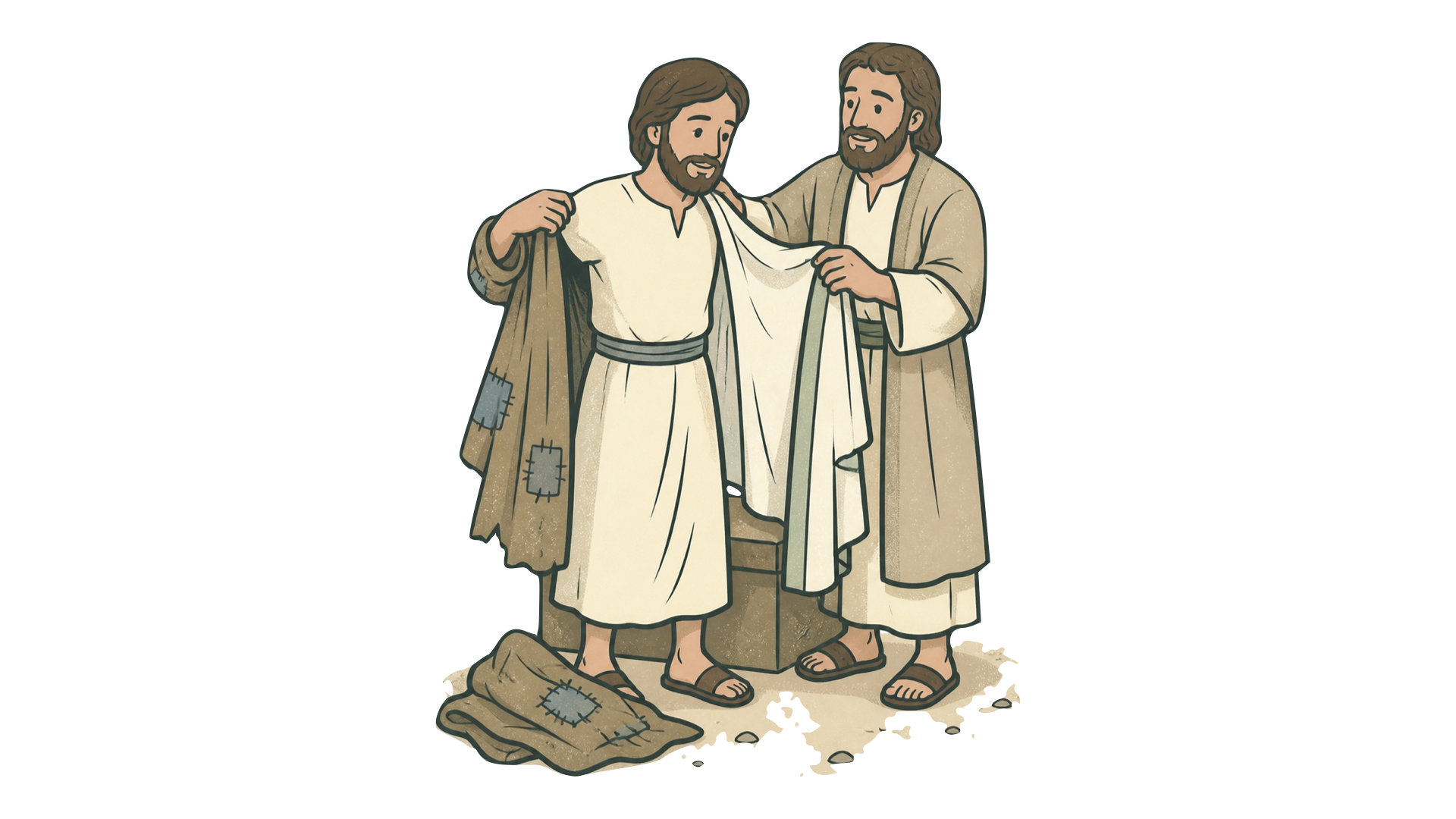
In our study tonight, we read through the second half of Ephesians chapter 4. The passage begins with Paul urging the Ephesians to stop living like the unbelieving Gentiles, who walk in the "futility of their mind," darkened, ignorant, and hardened in their hearts (v. 17-19). He then draws a sharp contrast, reminding them that this is not how they learned Christ. The core instruction is to "lay aside" the "old man"—their former way of life, corrupted by deceitful desires—and to be "renewed in the spirit of your mind" (v. 20-23). This renewal involves putting on the "new man," which is created in God's likeness, full of righteousness and holiness (v. 24). As one member pointed out, this isn't about creating a vacuum by just stopping old habits; it's a necessary change where we must actively fill our lives with the new way. The rest of the passage gives very practical, concrete applications of what this looks like: don't lie, but speak truth; don't let anger lead to sin or give the devil an opportunity; don't steal, but work hard to be able to share with others; let no unwholesome talk come from your mouth, but only words that build others up; and don't grieve the Holy Spirit (v. 25-30). The section concludes with a command to get rid of all bitterness, anger, and slander, and instead to be kind, tenderhearted, and forgiving, just as God has forgiven us in Christ (v. 31-32).
2. What is God revealing about humanity?
Our discussion revealed a lot about our own nature. A key point raised was that becoming a Christian isn't just a one-time choice but a "lifestyle change that affects every aspect of your life." Without Christ, humanity is characterized by ignorance and a hardness of heart, walking according to the flesh (v. 18). One club member used a powerful analogy, saying we have a "little bit of Christ that we should let... grow" and a "devil plant" that needs to be "cut down." We have a natural tendency to hold grudges, but the passage warns us, "Do not let the sun go down on your anger" (v. 26), which we noted is often driven by the selfish greediness of the old self. Another member pointed out that when we are angry, we "give the devil an opportunity" (v. 27), essentially creating a chink in our spiritual armor. We also saw a principle of growth: whatever we plant in our minds is what will grow. Bitterness can snowball into anger, wrath, shouting, and slander (v. 31), just as kindness can grow into tenderheartedness and forgiveness (v. 32). Our words have power; we can either tear people down or, by speaking truth, build them up in the spirit.
3. What is God revealing about Himself?
In our study, we saw that God is actively involved in our transformation. He desires for us to walk on the right path, not the destructive path of the world (v. 17). A powerful truth we discussed is that God wants us to be in His likeness. When we put on the "new man," He creates us anew "in righteousness and holiness" (v. 24). As someone highlighted, God puts part of His very nature into us when we walk by the Spirit; unlike any other god, He gives of Himself to His believers. This is the "new creation" that takes place when we allow His Spirit to transform us. We also learned that God has deep feelings. The passage explicitly states, "do not grieve the Holy Spirit of God" (v. 30). Our actions can genuinely hurt God. He isn't a distant, stone-faced being; He worries and cares for us deeply, like a parent, when we don't choose the new life He offers. Finally, and most importantly, we were reminded that God has "graciously forgiven" us (v. 32), and He invites us to participate in that same grace by extending it to others.
4. How should our lives change?
The applications from this passage are incredibly direct and practical. As one of our youngest members pointed out, it starts with having "total faith in Jesus," just like John the Baptist. This faith leads us to the first step: consciously choosing to "lay aside the old man" and then actively "put on the new man" (v. 22, 24). A central application for all of us is to be extremely careful about what we put into our minds. As one person shared, "you have to be cautious of what you put in your... brain because that's going to stay." This means evaluating the books we read, the movies we watch, and the music we listen to, and asking: "Are we putting in the lies of the world or the truth of Jesus?" We must choose to plant the seeds that will grow the new self. This new life is then manifested in our actions. We should work with our hands not just for ourselves, but "so that he will have something to share with one who has need" (v. 28). Ultimately, our lives should change to reflect God's forgiveness toward us; we are called to "be kind to one another, tenderhearted, graciously forgiving each other, just as God in Christ also has graciously forgiven you" (v. 32).