Building Up In Love (Ephesians 4:1-16)
Ephesians 4:1-16
This is a recap of our Bible Caller Club meeting on June 14th, 2026 over this passage. If you want to join the club and attend future meetings and study with us via phone, click here.
Context:
In our study on June 14, 2026, we began our look into the second half of the book of Ephesians. As we learned, this is a turning point from theology to application, starting with the word "Therefore." The overall context for the church at Ephesus involved a culture steeped in pagan worship and the occult, a warning from Jesus in Revelation that they had "lost their first love," and Paul's own prophecy that false teachers would come in among them, all leading to disunity. This passage flows directly from the first three chapters, which detail God's grace toward us, by explaining how we, in turn, should show grace toward one another by using our individual gifts to build up a unified church.
1. What’s happening in this passage?
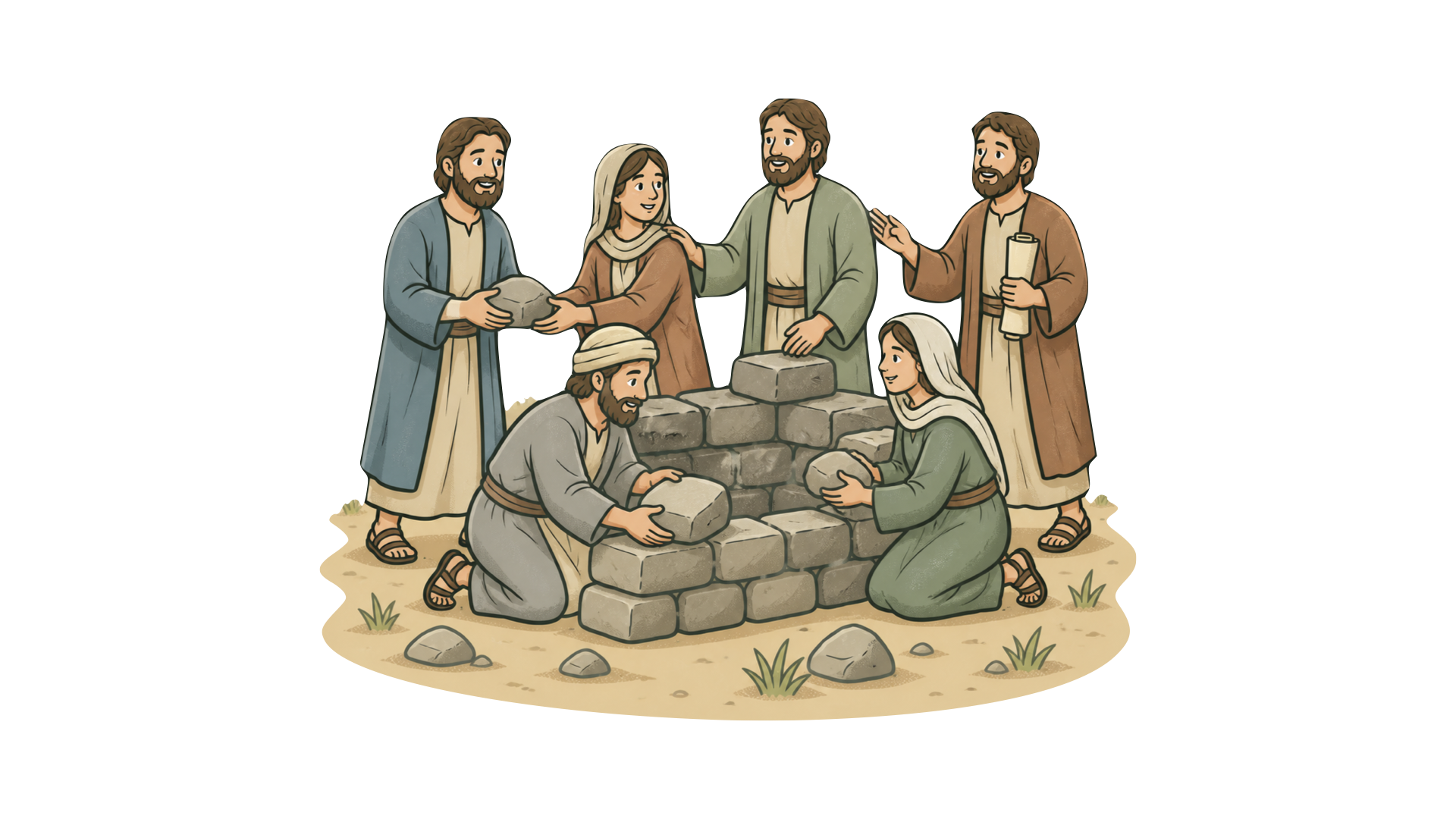
In our study tonight, we examined Paul’s passionate plea for unity within the church. The passage begins with Paul, calling himself a "prisoner of the Lord," exhorting the Ephesians to "walk in a manner worthy" of their calling (v. 1). As one member noted, this connects back to chapter 2, verse 10, which describes us as God's workmanship created for good works to walk in. The group discussed how this worthy walk is achieved: with humility, gentleness, patience, and love, all while diligently keeping the unity of the Spirit (vv. 2-3). The reason for this unity is then laid out in a powerful, repetitive list: there is one body, one Spirit, one hope, one Lord, one faith, one baptism, and one God over all (vv. 4-6). One person in our group remarked how emphatic Paul is with this list, making it clear to a culture surrounded by many gods that there is only one. The passage then transitions to explain the means for achieving this unity. Jesus, upon His ascension, gave gifts to all His "captives"—that is, all believers (vv. 7-10). These gifts are diverse—apostles, prophets, evangelists, pastors, and teachers—but they all share a singular purpose (v. 11). That purpose, as Paul explains, is to equip the saints for service, building up the body of Christ until everyone reaches maturity and unity, no longer being immature "children" tossed about by false doctrines (vv. 12-14). The goal is to "grow up in all aspects into Him who is the head, that is Christ," so that the whole body, with each part working properly, builds itself up in love (vv. 15-16).
2. What is God revealing about humanity?
Our discussion highlighted several key insights into human nature. One club member pointed out that we often feel jealous of the gifts others have, but Paul reminds us that each person has their own specific gift from Christ (vv. 7, 11). This can lead to a form of selfishness where we either envy others' gifts or, just as selfishly, neglect to use our own. As we discussed, it's easy to think our contribution isn't needed, but that mindset hurts the entire body. Another member astutely observed that "working together is a sign of maturity." Paul's contrast between being "children" (v. 14) and "growing up" (v. 15) shows that a sign of immaturity is being self-focused and needy, whereas spiritual growth leads us to serve one another. We also talked about our tendency to not be "diligent" in preserving unity (v. 3); when drama or misunderstandings arise, we often brush them aside or even leave, treating the church as something disposable. Finally, we tend to seek unity only with a small clique, rather than with the "whole body" as Paul commands (v. 16), revealing our natural inclination to form exclusive groups rather than embracing everyone as essential.
3. What is God revealing about Himself?
In our study, we saw a rich portrait of God's character and will. First and foremost, God is one (vv. 5-6). He is singular and unified, and this is the very foundation for His call for us to be one. As a member shared from the text, He is not just one, but He is "over all and through all and in all." God is everything. This connects to the idea that Christ fills all things (v. 10), and as we mature, every aspect of our lives and the church should be filled with Him, leaving no room for our own egos. It was also pointed out that God is a generous giver. He doesn't just command us to do good works; He lovingly equips us for them by giving each of us specific spiritual gifts (vv. 7-8). He has the perfect wisdom to determine which abilities each of us needs for the health of the whole church. God is also the head of the church (v. 15), and His power to lead and fill all things was established through His ultimate act of service and sacrifice—His death, burial, and resurrection (vv. 9-10).
4. How should our lives change?
This passage gave us several powerful and practical applications for our lives. One member shared a great insight: we shouldn't "pigeonhole" ourselves into thinking we have only one gift. Since the gifts are from God, we need to be open to how He might use us in different situations as opportunities arise. Another key takeaway is to actively strive to "walk in a manner worthy of our calling" (v. 1), which means consciously practicing humility, gentleness, patience, and love to maintain unity. We also discussed the need to change our motives. We should come to church not to have our own cup filled, but with a full bucket, ready to serve and build up others. This is a continuous effort; Paul says we are to do this "until we all attain" the fullness of Christ (v. 13), which, as we noted, is a lifelong process. We're never "done." Perhaps the most direct application, as one person said, is to simply stop being "children" (v. 14). We need to grow up, stop focusing on who is going to serve us, and start asking how we can use our God-given gifts to serve and build up the body of Christ.