He Who Has Ears to Hear, Let Him Hear (Luke 8)
Luke 8
This is a recap of our Bible Caller Club meeting on July 12th, 2026 over this passage. If you want to join the club and attend future meetings and study with us via phone, click here.
Context:
In our Bible study on July 12, 2026, we continued our journey through the Gospel of Luke, focusing on chapter eight. Coming out of chapter seven, this chapter continues the theme of how people respond to Jesus and the kingdom of God, illustrating that God’s transformative kingdom is for those who not only hear His word but also act on it and bear fruit.
What is happening in this passage?
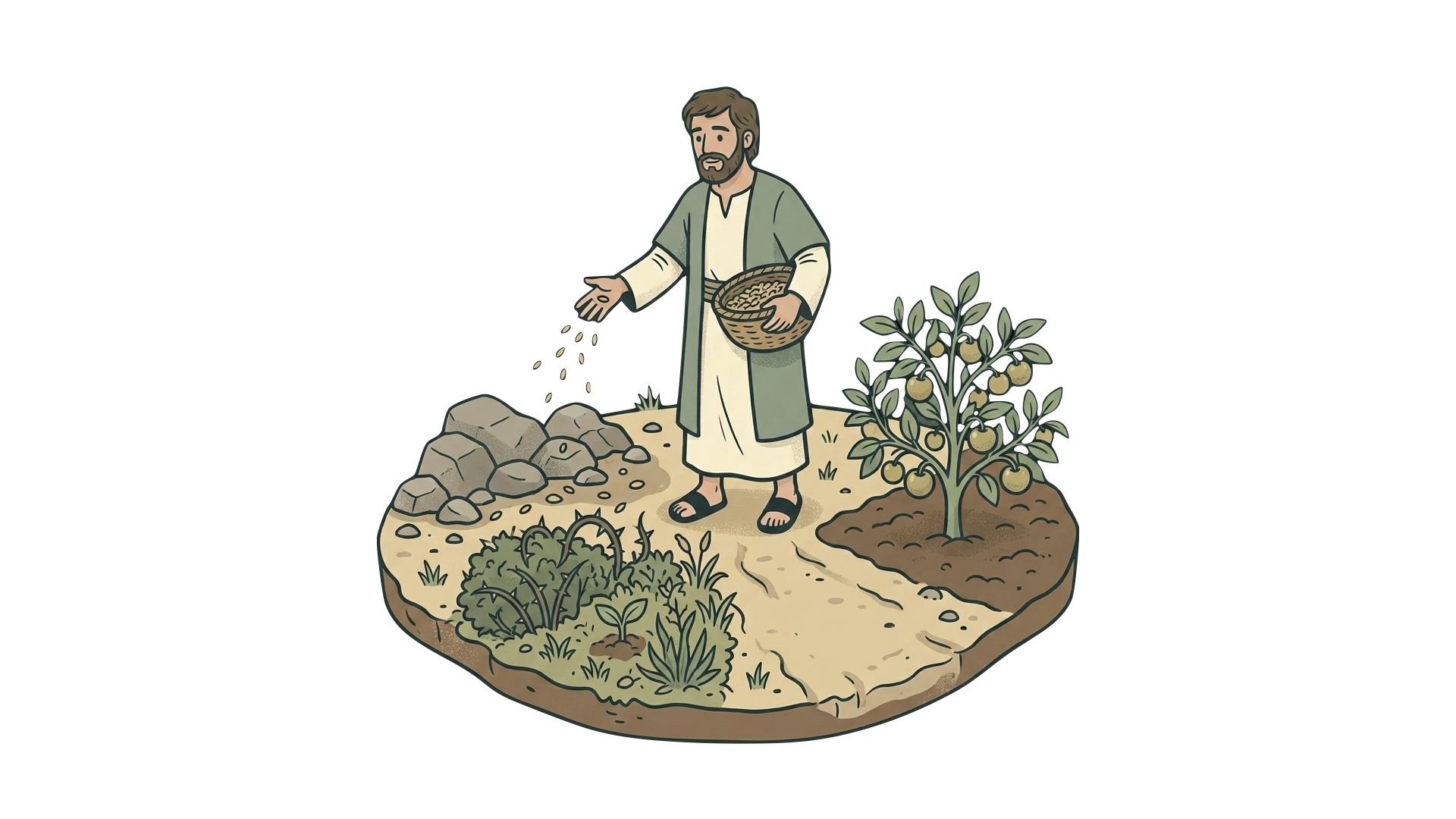
In our study tonight, we read through all of Luke chapter eight. The chapter begins with Jesus traveling and preaching the good news, accompanied by the twelve disciples and several women who supported their ministry, which was noted as radical for the time (Luke 8:1-3). The central teaching is the Parable of the Sower, where Jesus explains that the seed is the Word of God, but its fruitfulness depends on the soil—the condition of a person's heart (Luke 8:4-15). As we discussed, this isn't just a farming story; Jesus is explaining how His word is received differently by people, who represent the four types of soil. It's then followed by Jesus's private explanation of the parable to His disciples, where He encourages them to let their light shine and warns them to be careful how they listen, reminding them that our true family are those "who hear the word of God and do it" (Luke 8:16-21). The rest of the chapter provides real-life examples of faith in action, showing the seed from the parable reacting differently to different people. Jesus demonstrates his authority as he calms a violent storm, shocking his disciples (Luke 8:22-25), and casts a legion of demons out of a man, who then proclaims what Jesus did for him (Luke 8:26-39). The chapter concludes with two intertwined stories of desperate faith: a woman who had a hemorrhage for twelve years is healed by touching Jesus’s garment, and Jairus's daughter is raised from the dead (Luke 8:40-56).
What is God revealing about humanity in this passage?
A key revelation about humanity we discussed is that we all have a choice to make about what kind of soil we will be. As one of our younger members put it, we can choose to be on God’s side or the devil’s side by choosing whether or not to believe in Him. The seed, the Word of God, is always the same; what changes is the condition of our heart. A group member pointed out a common human tendency, reflected in the parable of the lamp: we receive the good news, but we often want to hide that light or let someone else do the sharing (Luke 8:16). We also see how people can get it wrong; when Jesus said Jairus’s daughter was "sleeping," the crowd laughed at Him, interpreting His spiritual statement through a purely physical, fleshly lens (Luke 8:52-53). We also discussed the warning to "take care how you hear" (Luke 8:18). Many of us hear the word, but we don’t truly listen because we haven't emptied ourselves of our old ways and are not ready to be filled. Our hearts are cluttered, and we can't hide anything from Jesus; we must come to Him by opening up our lives completely, just as the woman with the hemorrhage did (Luke 8:47).
What is God revealing about himself in this passage?
During our discussion, we noted that this chapter reveals a powerful picture of who Jesus is. He is the one actively sowing the seed of the word, calling out, "He who has ears to hear, let him hear" (Luke 8:8), because He desperately wants us to seek Him with an open heart. A member found it fascinating that when the woman touched Jesus' garment, Jesus felt power go out from Him, showing He possesses a divine power that is distributed based on people's faith (Luke 8:46). As another person added, this connects to times when Jesus could not do many miracles because of people's disbelief; His power isn't limited by anything except our own lack of faith. We saw that Jesus is the "Son of the Most High God" (Luke 8:28), holding absolute authority over all chaos, whether it's a storm or a legion of demons. The group also highlighted God's grace; when Jesus speaks in parables "so that seeing they may not see," it isn't to cruelly exclude people but a gracious act of not forcing the kingdom on those who don't want it. The most powerful revelation we talked about is that God actively looks for us when we are looking for Him. When the woman searched for Jesus, Jesus then turned and searched for her, giving her peace.
How should our lives change having studied this passage?
The applications from our discussion were very personal and challenging. A major takeaway was the need to ask ourselves, as one member put it, "What am I going to do with Jesus?" This is a daily question. We must decide if we're going to be the "good soil" by having honest hearts that truly hear God's word and persevere. Faith is not passive. As Jesus says, his true family are those "who hear the word of God and do it" (Luke 8:21). We should be like the people in the stories who called out to Jesus, touched his garment, or fell at his feet. We were challenged by the idea that if we are hiding our light, we may not be the good soil we think we are, because that fruit is not for ourselves. Another member urged us to "check our fear against our faith," remembering who Jesus is. We were encouraged to be like the woman who was desperate enough to push through the crowd just to touch the fringe of His garment, drawing close to Him with confidence. Ultimately, we must be careful not only to hear the word but to live it out and share it, because "whoever has, to him more shall be given; and whoever does not have, even what he thinks he has shall be taken away from him" (Luke 8:18).