The Son of Man is Lord of the Sabbath (Luke 6)
Luke 6
This is a recap of our Bible Caller Club meeting on July 9th, 2026 over this passage. If you want to join the club and attend future meetings and study with us via phone, click here.
Context:
In our study on July 9, 2026, we explored the context leading into Luke chapter 6, noting that Luke's purpose is to give certainty about the things we've been taught by highlighting Jesus' humanity and historical reality. The preceding chapters established a theme of people searching for and waiting on Jesus, and chapter 5 ended with Jesus' teaching about new wine needing new wineskins, symbolizing that one must let go of the old to embrace the new kingdom He brings.
What is happening in this passage?
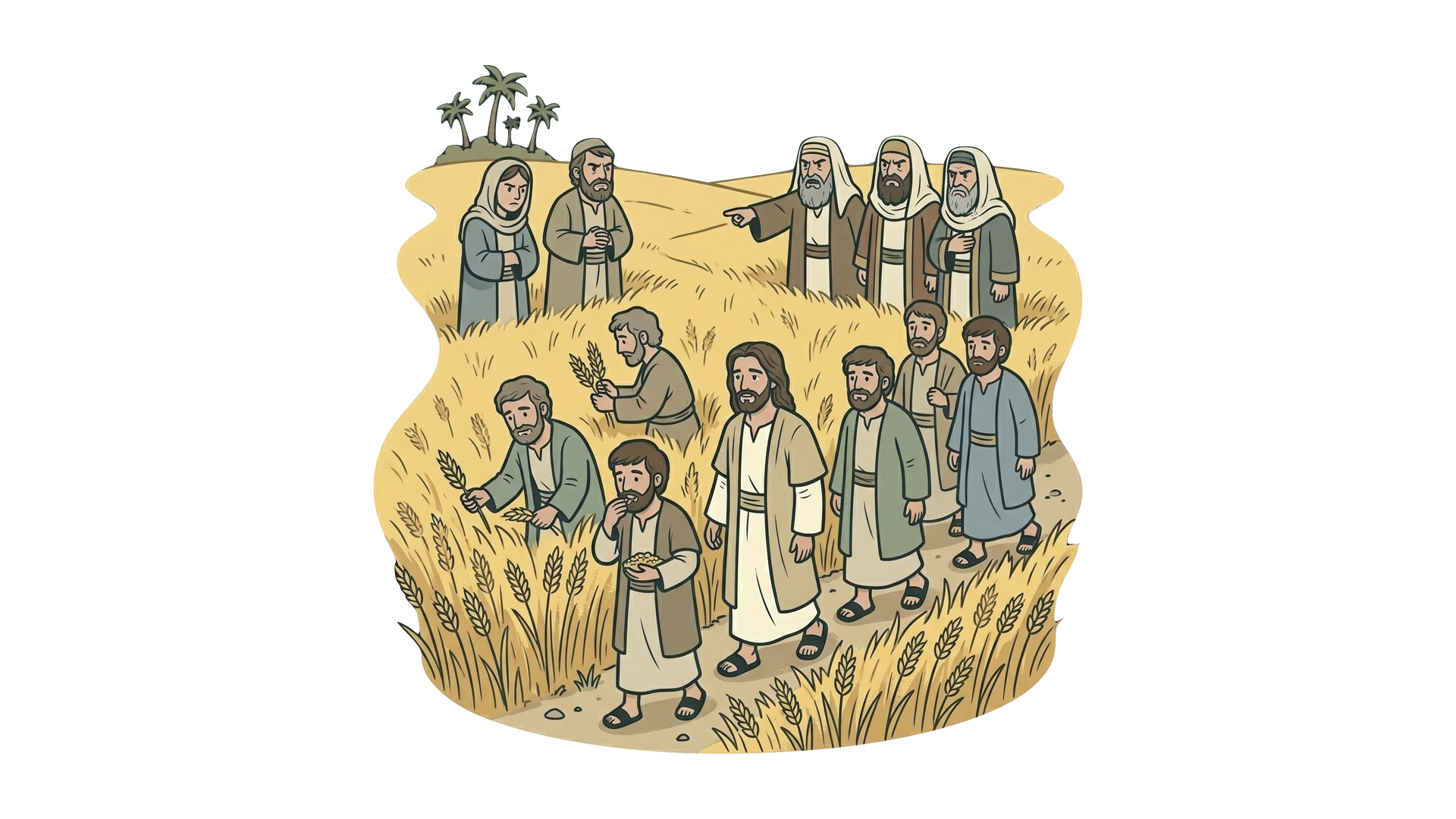
This week's study covered the entirety of Luke chapter 6, a passage packed with action and deep teaching. The chapter opens with two confrontations on the Sabbath. First, Jesus' disciples pick grain to eat, and second, Jesus heals a man with a withered hand in the synagogue (Luke 6:1-11). In both instances, the Pharisees challenge him for breaking their rules, but Jesus counters by prioritizing human need over rigid legalism, declaring, "The Son of Man is Lord of the Sabbath." Following this, Jesus goes to a mountain to pray all night before choosing his twelve apostles from among his disciples (Luke 6:12-16). He then comes down to a level place where a great multitude has gathered to hear him and be healed, and power flows from him, healing them all (Luke 6:17-19). The remainder of the chapter is a powerful sermon, often called the Sermon on the Plain, where Jesus lays out the principles of his kingdom. He shares the Beatitudes ("Blessed are the poor...") and corresponding woes ("Woe to you who are rich..."), teaches his disciples to love their enemies, and warns against judging others (Luke 6:20-42). He concludes with parables about trees and their fruit and the wise and foolish builders, emphasizing that a true follower is one who not only hears his words but puts them into practice (Luke 6:43-49). As one club member pointed out, the entire chapter serves as a contrast between Jesus, who cares for people, and the Pharisees, who only care about rules.
What is God revealing about humanity in this passage?
In our discussion tonight, we saw that this chapter reveals a fundamental division within humanity: the self-righteous who reject God's kingdom versus the humble who seek Jesus. One member noted that we often tend to build our lives on the wrong foundation, a foundation of self or even religious traditions, rather than on the words of Jesus (Luke 6:46-49). Another person pointed out our natural tendency to focus on the faults of others—the "speck" in their eye—while ignoring the "log" in our own (Luke 6:41-42). We can easily become like the Pharisees, making rules for others and missing the heart of God's law, which is mercy. As someone mentioned, we can make excuses for not doing good and miss the bigger picture. This chapter shows that we all face a choice: will our priorities lead us to be called "blessed" or "woe to you"? Ultimately, our group concluded that we tend toward hypocrisy and must have a transformed heart, a "new wineskin," to produce the good fruit God desires.
What is God revealing about himself in this passage?
Our study highlighted several key aspects of God's character. A member drew our attention to verse 36, where Jesus commands, "Be merciful, just as your Father is merciful." This reveals that God's very nature is one of mercy and kindness, even "to the ungrateful and evil" (Luke 6:35). Jesus, as the Son of God, perfectly embodies this character. He is not a respecter of persons; when the crowd came to him, "power was coming from him and healing them all" (Luke 6:19). No one who came to him in faith was excluded. Another member observed that God doesn't care about our status, wealth, or job; He cares about the posture of our heart. He prioritizes life and mercy over legalism. This is why Jesus declares that the Sabbath was made for man, not the other way around. He is the master builder who provides the only true foundation—his words—that can save us from the destruction that comes from building on anything else.
How should our lives change having studied this passage?
Reflecting on this passage, our group identified several ways our lives should change. One powerful application is that we must actively look for ways to love others, especially our enemies, and step outside our comfort zones to do so (Luke 6:27-35). As one person noted, this is a hard teaching, as we are called to do good and lend "expecting nothing in return," which separates us from the way of the world. Another key takeaway was the need to work on "taking the beam out of our own eyes" before we dare to judge others (Luke 6:41). We need to focus on our own spiritual condition first. Another member reminded us of Jesus' example of praying all night before making a major decision (Luke 6:12), showing that our lives of service must be bathed in prayer. Ultimately, as someone pointed out from verse 40, a student who is fully trained will be like his teacher. Our goal is to become more like Jesus by coming to him with a humble heart—a new wineskin—ready to be trained by his words and to obey them, proving that He is truly our Lord.