Go Out Into the Deep; It's Where the Fish Are (Luke 5)
Luke 5
This is a recap of our Bible Caller Club meeting on July 7th, 2026 over this passage. If you want to join the club and attend future meetings and study with us via phone, click here.
Context:
In our Bible study on July 7, 2026, we continued our journey through the Gospel of Luke, which aims to provide an orderly account so we can have certainty about Jesus. This specific passage in chapter 5 follows the testing of Jesus in the wilderness and the contrasting reactions to him in Nazareth (rejection) and Capernaum (acceptance), setting the stage for Jesus to begin calling his disciples and demonstrating his authority.
1. What’s happening in this passage?
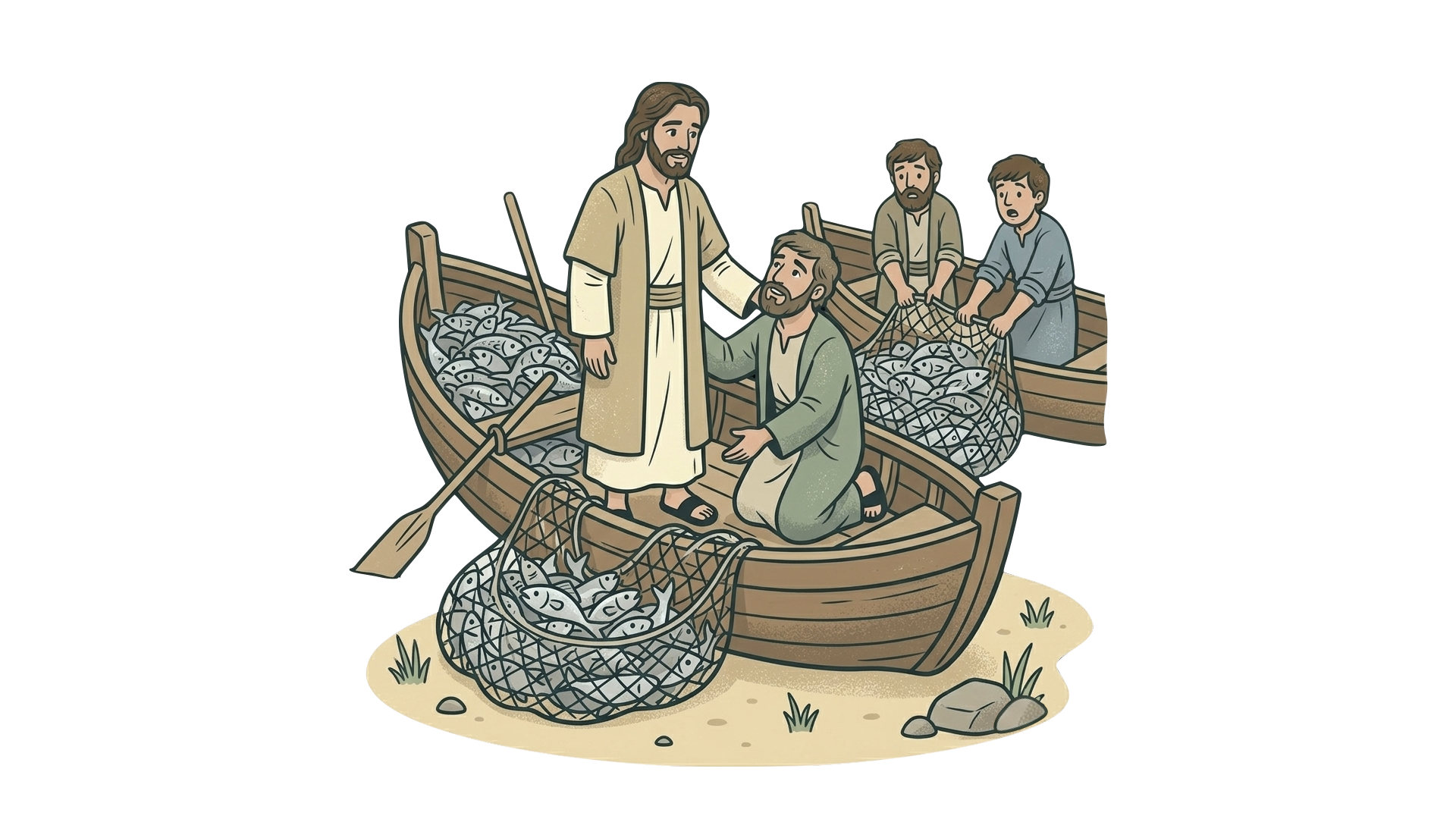
Our study session tonight walked us through the five main events of Luke chapter 5, which show Jesus calling people to a new kingdom. The chapter opens with Jesus teaching from Simon's boat after a night of fruitless fishing. At Jesus' command to "put out into the deep water," Simon lets down the nets again and is rewarded with a miraculous, boat-sinking catch of fish (vv. 1-7). This leads to Simon Peter's confession of his sinfulness, and Jesus's famous call for him, James, and John to become "fishers of men," after which they leave everything to follow him (vv. 8-11). Next, Jesus encounters a man with leprosy who expresses faith, saying, "Lord, if you are willing, you can make me clean." Jesus shows both his willingness and his power by touching and healing the man (vv. 12-16). The third event sees Jesus teaching in a house so crowded that a group of friends lowers their paralyzed friend through the roof. Seeing their faith, Jesus first forgives the man's sins—drawing accusations of blasphemy from the Pharisees who believed only God could forgive sins—and then proves his authority to forgive by telling the man to get up and walk, which he does, astonishing the crowds (vv. 17-26). Afterward, Jesus calls Levi (Matthew), a tax collector, to "Follow me," and Levi also leaves everything to do so, hosting a large reception for Jesus with other "sinners" (vv. 27-29). The chapter concludes with the Pharisees questioning why Jesus's disciples eat, drink, and don't fast like others, and Jesus responds with parables about not putting new wine in old wineskins or a new patch on an old garment, illustrating that His new kingdom cannot be contained within the old, rigid structures of the religious leaders (vv. 30-39).
2. What is God revealing about humanity?
During our discussion, it became clear that this chapter reveals a lot about our human condition. As one club member pointed out, we are all "catching something" in life; without Jesus, we spend our efforts on temporary things and, like Peter fishing all night, often come up empty, weary, and discouraged (v. 5). Several members noted that we have a hard time letting go of the past and our sense of control. Like the scribes and Pharisees, our tendency is to cling to the old, familiar ways, thinking, "The old is good enough" (v. 39). Leaving everything behind is a scary prospect that requires a level of trust we don't naturally possess. However, the passage also shows our potential for great faith. The leper's plea, "Lord, if you are willing, you can make me clean," highlights that if we are willing to humble ourselves, acknowledge Jesus as Lord, and ask for His help, we can be cleansed (v. 12). The faith of the paralytic's friends also demonstrated that when we act together and with confidence, we can experience God's miraculous power and bring others to Him. The chapter forces us to ask whether we identify with the humble, seeking faith of sinners or the self-righteous pride of the religious leaders.
3. What is God revealing about Himself?
In our study tonight, we saw God’s character revealed powerfully in the person of Jesus. One of the clearest revelations is Jesus's divine authority. He has authority over nature (the miraculous catch of fish), over sickness (healing the leper), and most significantly, authority on earth to forgive sins (healing the paralytic, v. 24). One member immediately pointed out that by forgiving sins, Jesus is unequivocally declaring His divinity, stating "I am God" (v. 21). He is also full of love and compassion; we learned that God, in Jesus, is always willing to heal and cleanse us when we come to Him, and we are never a burden. He responded not just to an individual’s faith, but to the faith of friends interceding for another (v. 20). As Jesus says himself, "I have not come to call the righteous but sinners to repentance" (v. 32), a direct fulfillment of his mission. A key insight was that God is bringing about something entirely new—a new covenant of forgiveness through faith, not self-righteousness through rules. He provides both the "new wine" and the "new wineskins," a completely new and better way to relate to Him.
4. How should our lives change?
This passage left our group with a powerful call to action. The most prominent takeaway, as one member put it, is that we need to get our priorities straight and be willing to "go out into the deep" (v. 4). This means stepping out in faith even when it's uncomfortable and our toes can't touch the sand, trusting that Jesus will provide. We are called to stop fishing for the temporary things of this world and instead become "fishers of men," joining Jesus in his mission (v. 10). A theme we saw repeated was the phrase "they left everything and followed him" (vv. 11, 28). This is a challenge to us to let go of the "old"—our old ways of thinking, fruitless efforts, and self-reliance—and embrace the "new" that Jesus offers. We must be willing to let go of our comfortable "old wine" and embrace the new, better wine of his kingdom. We should also pray with confidence, like the paralytic's friends, for those in our lives who are spiritually paralyzed, because our faith can be a powerful instrument for their healing. As we are transformed by embracing the "new wine," people will see the change in us and glorify God.