Clothed With Christ (Galatians 3)
Galatians 3
This is a recap of our Bible Caller Club meeting on June 4th, 2026 over this passage. If you want to join the club and attend future meetings and study with us via phone, click here.
Context:
On the evening of June 4, 2026, our group gathered to study Galatians chapter three. Paul is writing this letter because the Galatian believers were being led astray by false teachers who insisted that Gentile Christians had to follow Old Testament laws, like circumcision, to be saved, when Paul's main point is that people are justified by faith in Jesus, not by works of the law (Galatians 2:16, 21).
1. What’s happening in this passage?
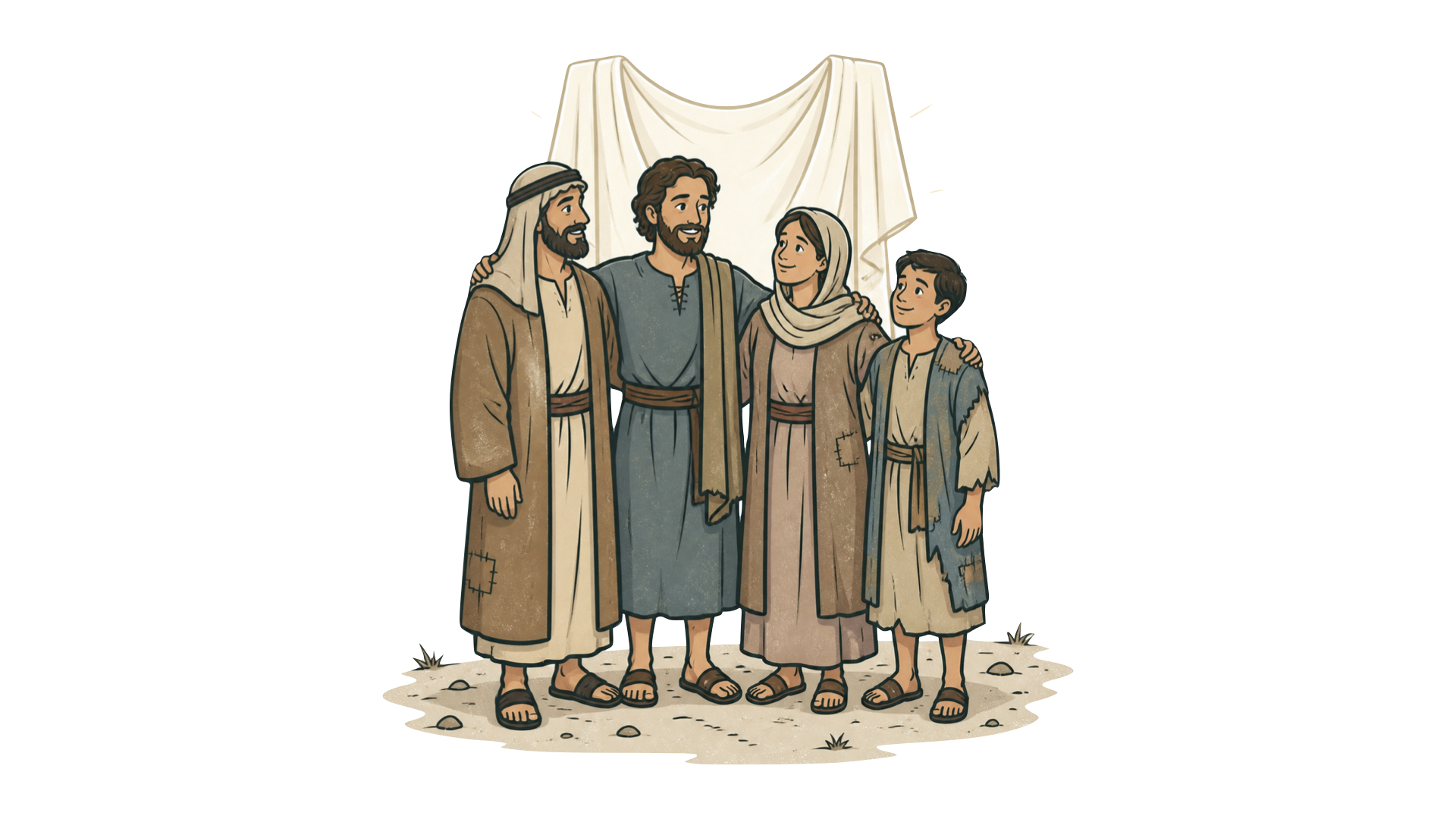
In our study tonight, we explored how Paul passionately argues that justification comes through faith, not by observing the law. He starts by calling the Galatians "foolish" for thinking they could be perfected by their own efforts (the flesh) after beginning their Christian lives through the Spirit (Galatians 3:1-3). As our group discussed, he’s asking them a powerful rhetorical question: did you receive the Holy Spirit by obeying the law, or by hearing and believing the gospel? Paul is making them recall their own experience to see the error of their new path (Galatians 3:5). He then uses Abraham as the primary example, pointing out that God's plan from the very beginning was to justify all nations through faith, as Abraham was declared righteous because of his faith long before the law was even given—430 years before, to be exact (Galatians 3:6, 8, 17). A group member highlighted how this promise to Abraham, a covenant ratified by God, couldn't be nullified by the law that came later; God is a promise keeper. Paul continues by explaining that trying to live by the law actually brings a curse, because no one can follow it perfectly (Galatians 3:10). As one club member pointed out, this is why Jesus had to come—he "redeemed us from the curse of the law, having become a curse for us" by dying on the cross (Galatians 3:13). The law's purpose, then, wasn't to save but to act as a "tutor," added to show us our sin and our need for grace, serving as a placeholder until Christ, the promised "seed" of Abraham, arrived (Galatians 3:19, 24). The chapter concludes by explaining that now, through faith, all believers are children of God, "clothed" with Christ, making us one family and heirs to the promise, regardless of our earthly status (Galatians 3:26-29).
2. What is God revealing about humanity?
Our discussion revealed some key insights into human nature. A key point raised was our tendency to have a hard time changing our ways and to default to what is familiar. Paul highlights the absurdity of this, asking, "Having begun by the Spirit, are you now being perfected by the flesh?" (Galatians 3:3). One member pointed out that we often prefer to be followers, to be influenced by what others tell us because it feels safer than stepping out and leading. We have a tendency to want very explicit instructions and clear checkpoints to measure our progress, as another person shared, because it gives us a sense of control. This can be dangerous, however, because we can end up creating our own artificial rules to decide if we are a "good Christian," which can be just as problematic as following the Old Testament law. We also noted that we can be "bewitched" by false teaching and fail to think logically, as Paul points out to the Galatians (Galatians 3:1). Ultimately, without Christ, we are defined by our earthly distinctions and are left "unclothed" and ashamed; our efforts to establish our own righteousness are futile and lead only to a curse (Galatians 3:10).
3. What is God revealing about Himself?
During our study, we saw that God is a God of promise and faithfulness who, as one club member put it so well tonight, "does have a plan in motion." He made a covenant with Abraham based on faith, and He kept that promise through centuries, never letting the law invalidate His original plan (Galatians 3:17). We also see God's immense grace. He didn't leave humanity under the curse of the law which we could never fulfill; instead, He provided the perfect solution by sending Christ to become that curse for us (Galatians 3:13). A mind-blowing realization for our group was how God sees us. When we are clothed with Christ through baptism, God no longer sees our earthly distinctions like race, social status, or gender (Galatians 3:27-28). Paul first identifies "Abraham's seed" as Christ (Galatians 3:16), but then later says that believers are "Abraham's seed" (Galatians 3:29). As one person put it, when God looks at a believer, "He looks at you and he sees Jesus." God wants us to be His heirs and part of His family.
4. How should our lives change?
This passage from Galatians calls us to find our confidence not in our own efforts, but in the finished work of Christ. We concluded that if we want God to work powerfully in our lives, it has to be through faith in Jesus, not through thinking we are good enough on our own (Galatians 3:5). As one member shared, Paul was trying to give the Galatians confidence in the gospel they had first received, so they wouldn't be "wishy-washy" but could know they are saved. Someone in the group explained that the more we love God and love others, the less we focus on ourselves and the idea that our own actions can save us. We must also be careful not to create our own artificial systems or rules for others, judging them or requiring them to prove their worth before we offer fellowship. This truth should free us from comparing ourselves or seeing people through worldly labels. Because we are all "one in Christ Jesus" (Galatians 3:28), our identity is found in Him, not in our status or ability to follow rules. Another member pointed out the great hope in verse 4: if we are in Christ, our suffering is not for nothing. We should live with the assurance that we are children of God and heirs to His promise, not because of what we do, but because of who we belong to.