The Cup Of The Lord Vs. The Cup Of Demons (1 Corinthians 10)
1 Corinthians 10
This is a recap of our Bible Caller Club meeting on May 10th, 2026 over this passage. If you want to join the club and attend future meetings and study with us via phone, click here.
What a great discussion we had in our Bible study tonight! We dove into the challenging words of Paul in 1 Corinthians chapter 10. The conversation brought out some powerful truths as we worked through this passage together. It's always a blessing to gather, even over the phone, to dig into God's Word. Here's a summary of what our group discussed.
1. What’s happening in this passage?
In our study tonight, we began by summarizing the flow of 1 Corinthians 10. Paul starts by using the history of Israel in the wilderness as a powerful example for the Corinthian church (1 Corinthians 10:1-5). A group member pointed out that Paul emphasizes the word "all"—they all passed through the sea, all were under the cloud, and they all ate the same spiritual food and drank from the spiritual rock, which was Christ. They had every spiritual advantage and every reason to be faithful, yet God was not pleased with most of them. Why? Because, as we noted, "they craved evil things" (1 Corinthians 10:6). Paul then lists their specific failures—idolatry, sexual immorality, testing the Lord, and grumbling—implying that the Corinthians were falling into the same traps (1 Corinthians 10:7-11).
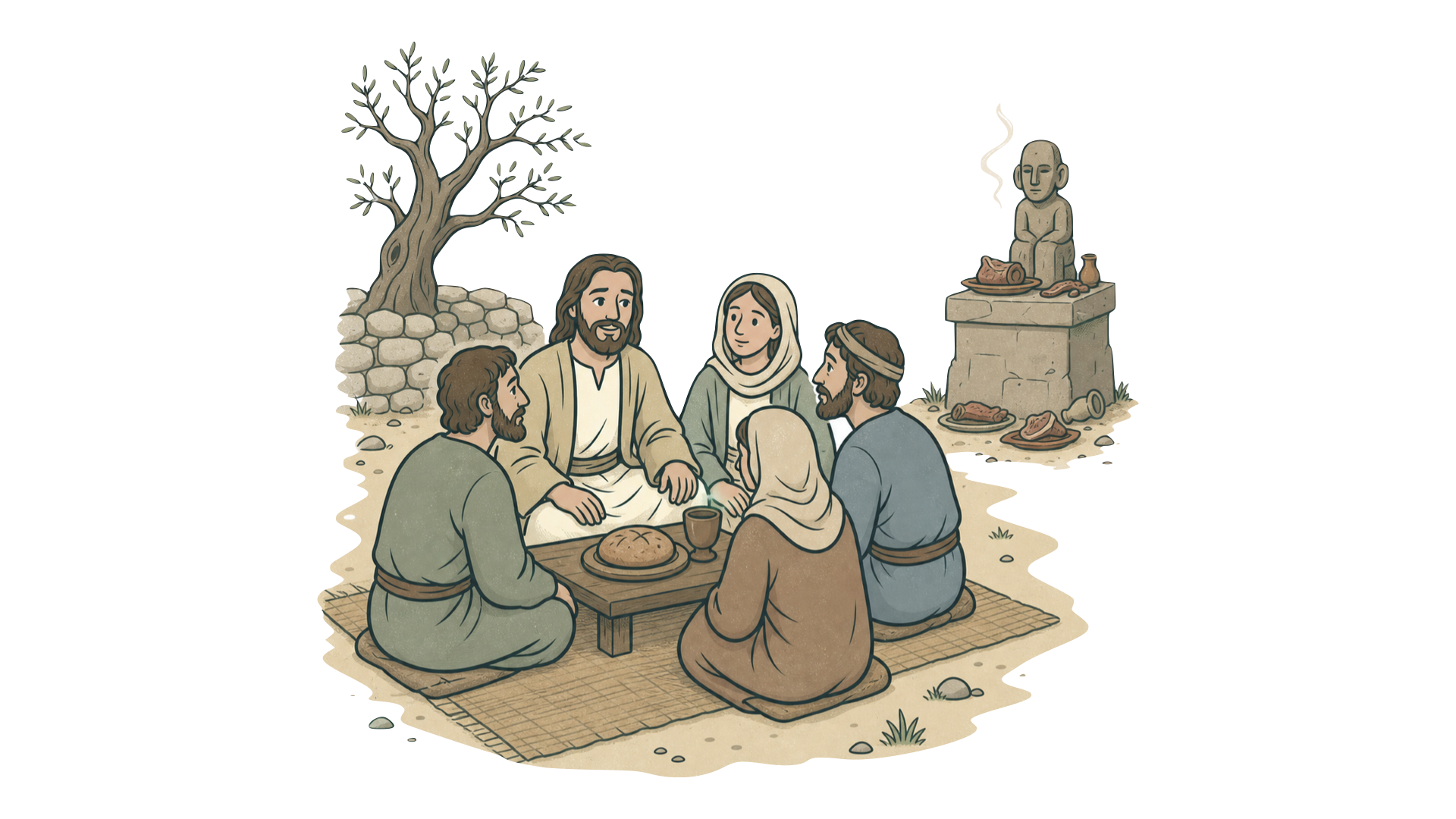
This leads to a crucial warning and a promise: "Therefore let him who thinks he stands take heed that he does not fall" (1 Corinthians 10:12). But right after this, Paul gives the incredible assurance that God is faithful and will always provide a way of escape from temptation (1 Corinthians 10:13). The discussion then shifted to the central choice Paul presents: you can't participate at both the Lord's table and the table of demons (1 Corinthians 10:15-22). We are called to flee selfishness and participate in the unified body of Christ. The chapter concludes with practical advice on Christian freedom: while "all things are lawful," not everything is profitable or builds others up. We should act not for our own good, but for the good of others, doing everything—even eating and drinking—for the glory of God (1 Corinthians 10:23-33).
2. What is God revealing about humanity?
Our group discussion highlighted several key insights about human nature. We noted that we all share the exact same temptations as the Israelites and the Corinthians. We struggle with idolatry (often putting ourselves first), sexual immorality, testing God, and grumbling (1 Corinthians 10:7-11). We are prone to selfishness and wanting to be our own gods. It's a moment-by-moment decision to choose God's way over our own. As one person mentioned, it's like what Paul said at the end of chapter nine about disciplining his body like an athlete; it takes constant training to adopt a mindset of sacrifice. It's not our natural tendency. Another point made was that we do have rights and freedoms in Christ, but the real test of our character is whether we are willing to set those freedoms aside for the sake of a brother or sister who might be struggling (1 Corinthians 10:28-29). The issue with the meat sacrificed to idols was a specific example, but the principle applies to any area of our lives where our freedom could cause another to stumble.
3. What is God revealing about Himself?
During the meeting, a member made an excellent point that a key attribute of God revealed here is His desire for unity. The passage contrasts the division caused by sitting at the "table of demons" with the unity found by sharing in the "cup of blessing" and the "one bread" at the table of the Lord (1 Corinthians 10:16-17). Jesus is the unifying element. God is also revealed as a "jealous God" (1 Corinthians 10:22), not in a petty human way, but in that He righteously desires the exclusive worship and devotion of His people. He invites us to His table. We also spent time on the powerful truth from verse thirteen: God is faithful. He knows our struggles and our weaknesses, but He promises not to allow us to be tempted beyond what we can bear. He always provides the "way of escape," which is ultimately found in submitting to Him and living out the gospel. By giving us the example of Israel and the ultimate pattern of Christ, God shows He is instructive and merciful, providing everything we need to live for Him.
4. How should our lives change?
The final part of our discussion focused on application. The most significant takeaway is that we must consciously choose which table we will sit at. This means choosing the table of Christ—a table of sacrifice, service, and submission—in our daily kingdom living. We are called to participate in the gospel message, to drink the "cup of suffering" with Christ for the good of others. One person emphasized that we cannot grow or be unified unless we are actively studying the Bible. The Israelites had the "spiritual rock," which was Christ, following them and offering spiritual drink, but they had to choose to drink it (1 Corinthians 10:4). We, too, must be near the rock and drink from His Word. Another member astutely pointed out that there is a time for grace and considering others, and a time to take a stand. We must be willing to lay down our personal rights to build others up, but there are also core truths we must never compromise. Ultimately, every single element of our lives, "whether you eat or drink, or whatever you do," should be done for the glory of God (1 Corinthians 10:31). As we discussed, this means living our lives through the lens of the gospel, taking up our cross daily to reflect His glory to the world.